“History constantly reminds us that those who lived in the past were once as real as we are. Before long we shall be the shadows that they seem to us now. We are all, the living and the dead, bound together by the same ultimate mystery – the mystery that gives life its depth, its wonder, and perhaps even its hope. To have touched the past, even in fragments, is to have touched something immense in its intangible meaning.” – Edgar Andrew Collard extracted from “Hay Township Highlights: 150 years of Diversified Progress, 1846 – 1996”, published by the Hay Township Book Committee under the auspices of Hay Township Council, Alice Gibb ed.; pg. iii ISBN : 0-919939-43-0
Text and image from the Wikipedia article “Dashwood, Ontario”
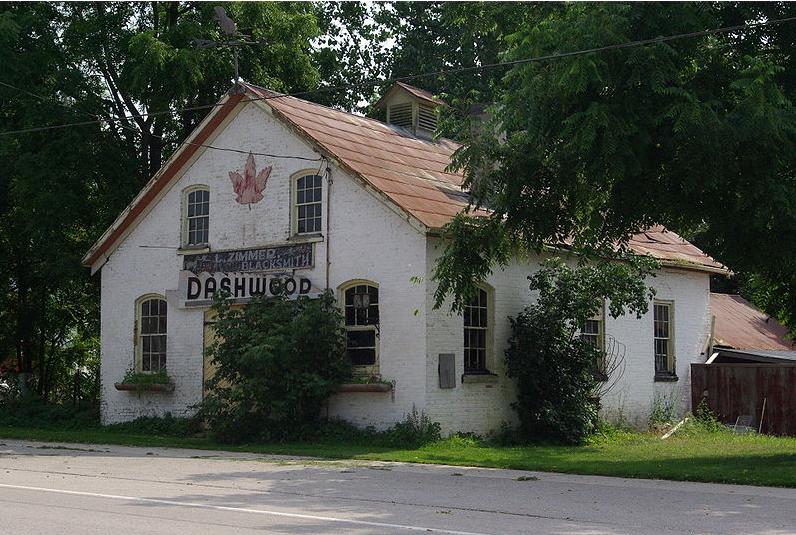
“Dashwood (original name Friedsburg) is a small, now primarily residential, community in southwestern Ontario, Canada. The former police village is located at the intersection of Bronson Line and Dashwood Road, on the boundary between the Municipality of Bluewater, Ontario and the Municipality of South Huron, Ontario. The community is situated approximately 50 kilometers north west of London, Ontario near the resort village of Grand Bend, which is located on the south east coast of Lake Huron.
Dashwood began when the brothers Noah and Absalom Fried, formerly of Blandford-Blenheim, Ontario in Oxford County, resettled in the area in 1853. They first erected a sawmill, followed shortly by a gristmill, on the site of the future community serving the needs of the influx of mainly European settlers brought about by the local development of Canada Company lands earlier in the century. The location of the initial development of the mills was intended to occur at Sarepta, 2 kilometers (1.25 miles) east of the present site of Dashwood, on Dashwood Road. A change of circumstances brought about an alteration of the plans of the two brothers and lower cost land became available at the current site of the community. The name of the community changed from Friedsburg to Dashwood in December 1871, when a post office was opened, Noah Fried became the first postmaster. Although the subject of some debate, Dashwood was likely named after Dashwood House, in London England, the headquarters in Britain of the once regionally important Grand Trunk Railway. Peak economic activity occurred in Dashwood in the early to mid 20th century; primarily as a farm supply village and at its height included a number of mills, hotels, general stores,a regionally large scale window manufacturing company and an assortment of shops and services geared to its rural surroundings.” –