(below) Former location of S.S. No. 4 Sharon School House, Stephen Township. The site is located on the northeast corner of the present intersection of Huron Street and Babylon Line.
[googlemaps http://maps.google.ca/maps/ms?hl=en&ie=UTF8&t=h&msa=0&msid=213422929688104395304.00049b2d9578797b63218&ll=43.33267,-81.58061&spn=0.009365,0.012875&z=15&output=embed&w=300&h=300]
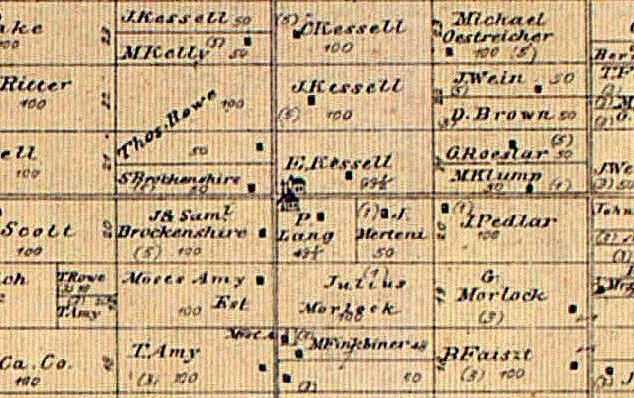
(below) Map from H. Belden & Co., 1879 Historical Atlas of Huron County. The crossroads in the centre of the map is the modern intersection of Huron Street and Babylon Line. The former site of the Sharon School is indicated by the symbol located on the northeast corner of the intersection. The symbol located on the southeast corner represents the presence of Sharon Bible Christian Church at that location in 1879. [Ed. note: In 1884 the Bible Christian Church amalgamated into the Methodist Church of Canada, which later became part of the United Church of Canada. By 1899, the Sharon church is identified as being Methodist in affiliation in financial reports and under the jurisdiction of the Crediton “circuit”. (“History of Stephen Township”; Susan Muriel Mack, page 269)] Click on the map for a larger version. North is up on the map.
“The settlers of the Sharon community presented a petition to the Stephen Township Council, and Bylaw 37 was passed on October 20, 1855, to authorize the setting up of School Section No. 4. Joshua Pedlar was authorized to call the first meeting at the home of Moses Amy, November 8, 1855.
In 1856, a log school was erected. On June 20, 1863, some land was bought for five shillings from Ed Kestle by Moses Amy. On January 20, 1871, an additional half acre of land was purchased for the sum of $80 per acre from Ed Kestle on the same lot. [Ed. note: $80 in 1871 funds is roughly equivalent to $1,500 in today’s money.] According to records which are available for 1884, the trustees of S.S. #4 were Wm. Rowe, G. Morlock and N. Kestle.
On July 2, 1888, a special section meeting was called and it decided to tear down the log school and build the present brick school. One half acre of land was purchased from William Kestle for $44 in 1908 to enlarge the schoolyard. A new wire fence was erected to enclose the school grounds, and a woodshed was built. In 1921, an organ was purchased by the teacher and pupils for $25, from the Christmas concert proceeds.
In September 1930, musical instruction was started in the school with Roy Goulding, as the first instructor. He was succeeded by Lawrence Wein of Exeter in 1965. In 1935, Miss W. Frayne, teacher, and E.C. Beacom, inspector, influenced the board to install cupboards and purchase dishes to serve hot lunches to students.
Four years later, a piano was purchased by the board for $75. Farm Forum meetings were held at the school in the 1940’s. The school joined the Stephen Township School Area in 1945. Hydro was installed in 1950, one of the most welcome improvements at the school. Each June, a picnic was held for the school section. The teacher who occupied the teacher’s desk the longest was Miss Lavina Smith (Mrs. Irvine Finkbeiner).
Others who taught at Sharon were: Joseph Holmes, G.W. Lawson, M. Jennison, J. Truemner, Mathilda Oestricher, Lydia Oestricher, Margaret McMasters, Illa Hodgins, Helen Walper, Ada Webb, Jean Armstrong, Joyce Cooper and Katherine Becker. A special tribute should be accorded to Arthur Amy who was secretary-treasurer of the Sharon School for 25 years (1919-1944). He continued as secretary-treasurer of the School Area Board until 1955.
‘Through the doors of S.S. #4, Stephen, prominent men and women have come. For over 100 years, the little school house has administered learning and taught comradeship and leadership to many children’ – Excerpt from the Sharon Reunion Folder
The school was purchased by the Boy Scout Troop of Dashwood and used by the Scouts for several years. The school bell was stolen in January, 1975. Clifford Grasdahl eventually purchased the property and built a residence there.”
extracted from “The History of Stephen Township”, by Susan Muriel Mack, 1992; pgs. 291-294
****************************************************************
“We continue our journey west along the North Boundary until we reach Concession 8 and 9. This is known as the Finkbeiner Line. Here we digress to Sharon, the first corner south along the concession road. Sharon is also a biblical name: it refers to the fertile plain between the mountains of central Palestine and the sea. Several Englishmen settled around Sharon, including Thomas Rowe, the Kestle brothers, Samuel Brokenshire, Moses Amy and Joshua Pedlar. There were five Kestle brothers – Charles, Edward, Josiah, William and Albert. Further south were several families of German descent: the Morlocks, Schwartzs, Finkbeiners, Gaisers, Treitzs, Eilbers, Winds and Weins.
School Section #4 was established at the corner in 1855 and a log school was erected on the southwest corner of Lot 15. It was also used for religious services until a frame church was built in 1869. The church remained open until 1901 when most of the members joined the Crediton church. The church building was purchased by Mr. Kestle, who moved it to his farm to use as a straw shed.
The social life of the section centred around this corner for many years. Stories submitted to the local newspaper by the “Sharon news correspondent” indicate that the settlement was a busy place. The undated clippings were probably written in the late 1870’s or 80’s.
‘Drawing sand and gravel is the order of the day – Jacob Schwartz, drawing for his new barn to be erected next summer, Mr. M. Finkbeiner, who purposes raising his and Mr. John Morlock for the same purpose…Mr. John Pedlar is busy drawing sand. He believes in having the best in the way of improvements and intends to place a cement floor in the cellar of his house.’
‘On Saturday morning one of the men in the gravel pit had a very close call. As the gravel bank is frozen, the loose gravel is being taken away from underneath, the back being held up by props. Without the slightest warning a large section of the bank dropped away almost pinning one of the men under its jagged edges. A few inches closer would have done the deed. As it was his shoulder was slightly bruised and his coat cut.
‘Sunday’s blinding blizzard was the most severe the hamlet has experienced for a very long time. The concessions are badly drifted and traffic will be somewhat hampered for a time.’
‘The hens of this neighbourhood have struck for higher wages, therefore eggs will be higher next week.'”
extracted from “The History of Stephen Township”, by Susan Muriel Mack, 1992; pgs. 224-225