(below) The community of Dixie was centred on the present day intersection of Rodgerville Road and Parr Line.
[googlemaps http://maps.google.ca/maps/ms?hl=en&ie=UTF8&msa=0&msid=213422929688104395304.00049dd74c9047e232abf&ll=43.40829,-81.570053&spn=0.074825,0.102997&z=12&output=embed&w=300&h=300]
“Dixie was a small, thriving settlement which sprang up around the local sawmills. It was located north of where the Hay Swamp divides into east and west branches, and south of Zurich Road on Con. 6 and 7, extending east to Con.5. The settlement was large enough that a correspondent reported news from Dixie in the early Zurich newspapers.
The main settlement was on the corner of Lots 15 and 16, Con. 6 and 7 [Rodgerville Road and Parr Line]. It consisted of eleven houses, one sawmill and a hotel in 1879. This area had several 25 and 50-acre farms. A blacksmith shop on Lot 18, Con. 6 was operated by John Gorby. Using the traditional barter system, Gorby often performed chores in return for work or goods provided by the customer.
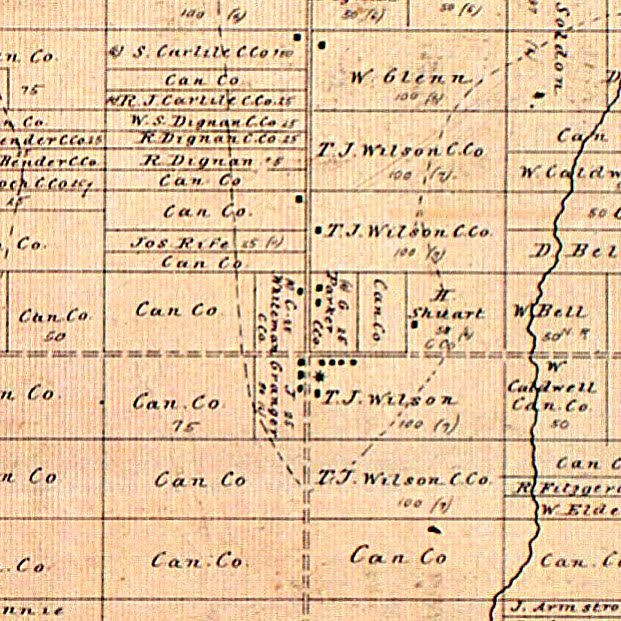
(right) North is up on the map.The cluster of structures surrounding what is today the intersection of Rodgerville Road and Parr Line is the core of the hamlet of Dixie. Take note of the cluster of “smaller” sized properties to the northwest, (upper left) and the extensive Canada Company land holdings in the area. The leasing of timber rights on adjacent Canada Company lands often provided ample material for a nearby sawmill. The mill at the close-by community of Slabtown was also dependent on just such an arrangement.
Another Dixie resident, Mr. Kipfer, made rocking chairs and miniatures in glass bottles, and delivered his handcrafted items by horse and buggy. Further south, Joe McDonald lived beside McDonald’s Bridge[?]. Old timers recall that he had several birthdays, each winter, throwing quite a party for each one! The following is a partial list of lease holders or land owners who lived in Dixie. They were: George Parker; T.J. Wilson (many lots); John Kyle; David Wanless; Samuel Carlisle; James Green; Warren S. Dignan; H. Kalbfleisch; M. Kuepfer (Kipfer); William J. Blackwell; L. Burkholder; D. Schroeder and A. Follick. George Gram of Dixie carried the mail from Zurich to Rodgerville by foot as a lad.
As the years progressed, work at the sawmills decreased. The smaller farms could no longer support a family. Finally the pits on Lot 15, which provided gravel to the farmers for “statute labour” to maintain the roads in front of their farms, were exhausted. Families began moving away, leaving behind only scattered remnants of the settlement of Dixie. The southerly portion of the settlement has been now reforested by the Ausable Bayfield Conservation Authority; the northern area is cash cropped by farmers. As a community, Dixie once sent more students to S.S. #3, than the area north of the Zurich Road. Dixie is but a pleasant memory today.”
extracted from “Hay Township Highlights: 150 years of Diversified Progress, 1846 – 1996”, published by the Hay Township Book Committee under the auspices of Hay Township Council, Alice Gibb ed.; pgs. 82-83 ISBN : 0-919939-43-0