(below) Hamilton and Ireland Planing Mill 1896. According to the 1904 Charles E. Goad Fire Insurance Plan of Dashwood, this structure appears to have been located just north of where the Community Living South Huron building is located today. This mill was destroyed by fire in 1908. Click on the image for a larger version.

“What became the original Dashwood Planing Mill started out as a corner furniture store owned by William Ball. Ball had a small shop in the back of his furniture business where he hand made mouldings, and small windows and sash in the winter with the help of his two stepsons, John and Henry Hoffman. They were able to manufacture enough windows and sash for about two houses per winter at this time.
John and Henry Hoffman soon went into business for themselves and built a planing mill north of their father’s furniture business in the 1890’s. Henry eventually went to work at Earl Guenther’s livery stable and John sold the planing mill for $2,700 to Sims and Ireland, Dashwood and Hamilton Brothers, of Grand Bend. [Ed. note: Henry Guenther (Earl’s father) purchased his livery business at the end of 1899. (Rader pgs. 66-67) The figure mentioned is the current equivalent of roughly $500,000.]
(below) The northeast corner of Dashwood Road (Main Street) and Fried Street in the early 20th century. The brick house in the foreground is the William Ball residence and business, with the entrance to a small workshop visible in its west wall. Click on the image for a larger version.

Among other things, the new Hamilton and Ireland Company made sash, doors, frames, mouldings, wagons, carriages, buggies and sleighs. The company became the Dashwood Planing Company, makers of sash and doors, in 1907 when Hamilton and Ireland sold out to Dan Schaffer, George Cook, Henry Brenner, George Kellerman, and Ezra Otterbein. The uninsured building was destroyed by fire in 1908, then started up again. Gradually the other partners dropped out until only George Kellerman remained as owner. This was the planing mill that Thomas Klumpp purchased for $1,600 in 1928.” [Ed. note: Approximately $90,000 in today’s funds.]
extracted from “A Look At Yesterday, Today and Tomorrow: Our First Millennium”, published by Dashwood Industries Limited; 1978
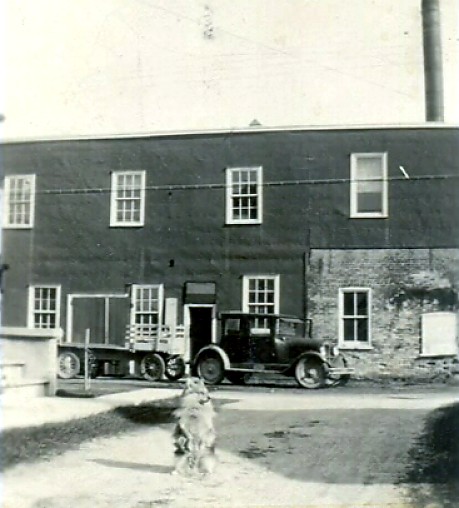
(below) The west face of the planing mill on Fried Street, circa 1928. This structure was destroyed by fire on Saturday, February 11, 1939. “[T]he Klumpp’s sawmill was selling the odd bit of lumber for barns and chicken houses in the area. This was delivered by means of Thomas Klumpp’s Model A Ford with a four wheel trailer on the back.”
“In 1930 Thomas Klumpp expanded his business by buying John Kaster Goetz’s steam powered sawmill across from the Lutheran Church in Dashwood. The mill, last of the stationary sawmills in the Dashwood area, was in bad shape so the Klumpp’s tore it down. They salvaged what material they could from the building and constructed a portable sawmill. They made a bit of money with this sawing logs for local farmers.”
extracted from “A Look At Yesterday, Today and Tomorrow: Our First Millennium”, published by Dashwood Industries Limited; 1978
“[A]t the beginning of 1939 the future looked rosy for the Dashwood mill. The company showed its first profit in 1938, possibly $1,000 or $2,000. [Ed. note: Roughly equivalent to $50,000-$100,000 in today’s funds.] Dashwood Planing Mill’s name was starting to become known and the company was starting to sell more products to builders. As a consequence the company did not have to depend fully on the highly seasonal farm trade.
Then disaster struck Dashwood Planing Mill at two o’clock in the afternoon of Saturday, February 11, 1939. A Hart-Parr gasoline tractor chopping at the north end of the plant caught fire and levelled the uninsured planing mill. When employees in the building, including Maurice and “Boots” [Howard], first noticed the fire they tried to douse it with dirt and sand from the floor of the mill. The harder they tried, the faster the flames spread. The employees then ran for the village fire engine, but unfortunately its hose was partially frozen and the unchallenged fire, fuelled by sawdust and wood scrap, jumped through the entire plant. By five o’clock in the afternoon Dashwood Planing Mill had been completely destroyed.
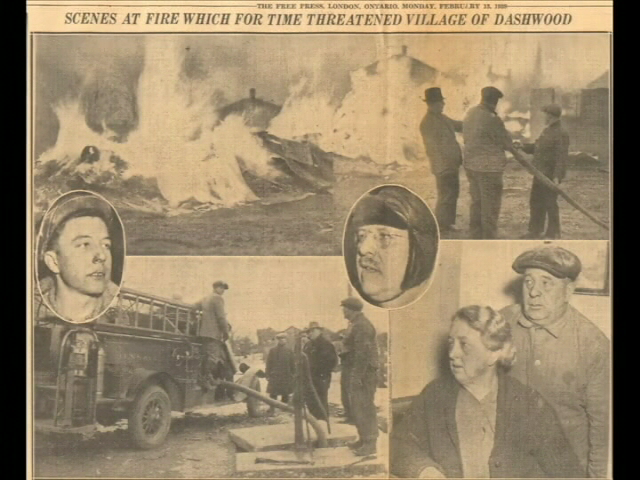
(left) Part of the London Free Press account of the fire. (left oval inset) employee Roy Bender, who first sounded the alarm. (right oval inset) Dr. R.H. “Hobbs” Taylor, a Village Trustee at the time. (lower right of image) The anguished faces of Amelia and Thomas Klumpp.
All the plant’s stock was destroyed except for 2,000 or 3,000 board feet of lumber that had been burning at both ends and was salvaged by workers and townspeople during the fire. Thomas Klumpp still had his home, and Maurice his, but the company still owed money for the lumber destroyed in the fire. The company had receivables [of] something like $12,000 showing on its book, but this of course was needed to pay off suppliers. Neither Thomas nor Maurice had any money in the bank and they were now several thousand dollars in debt.
‘Saturday night after things had settled down, my mother and father were two very sad looking people and felt that the world had turned against them’, Maurice said. ‘But the next day a lot of our good friends came along and offered their sympathy and asked if we were going to rebuild. But irregardless they offered their help on Monday morning to clean up the mess on the property. Monday morning there were at least ten teams of horses and seventy-five to one hundred people from outside and within the town and by Monday night at six o’clock the property was completely cleared of all machinery and debris. They gave us a new hold on life. My father immediately started to plan for the future.’
‘In the meantime, several towns approached the family and said if we would start a planing mill and lumber business in their town they would donate the property and buildings to get us going. Also, the Village of Dashwood called a meeting and suggested they would try and secure some funds to help us start again if we would remain on the same property in Dashwood. Five or six of our close friends went out into the community and asked for donations and people responded generously. You can imagine that financially times were still tough. And even if we received a donation of one dollar it was a great help. I believe when our friends finished they had picked up a total of about two thousand dollars. This was a great help in starting to erect a new plant.'”
[…]
“So Thomas Klumpp built a new plant. The new Dashwood Planing Mill rose on the old location using the the cement floor of the destroyed mill. The new plant was a one story cement block structure with a flat roof. Construction started early in March and by April 21, 1939, the Klumpp’s moved in with machinery and equipment.”
extracted from “A Look At Yesterday, Today and Tomorrow: Our First Millennium”, published by Dashwood Industries Limited; 1978
************************************
“William Ball’s furniture store was on the corner where the ARC Industries sign stands. He was married to Mrs. Hoffman, mother of John and Henry who worked for Ball. There was a shop in the back where they made mouldings, windows and sash by hand in the wintertime. They would make enough for two houses in one winter. John and Henry built the planing mill north of this. Henry went to work at the livery stable and John sold the mill to Dick Hamilton and Sim Ireland, who sold to Dan Schaeffer, George Cook, Henry Brenner, George Kellerman and Ezra Otterbein. These men dropped out one by one until George Kellerman was the sole owner. He sold to Thomas Klumpp in 1928.
It was a two story run down building. He had three employees, Alvin Kellerman, Levi Hamacher and Henry Calfas. Stuart Wolfe was an employee from 1935. On February 11, 1939, the mill was completely destroyed by fire with all the lumber on hand. Mrs. Klumpp [Amelia] was the hero of the fire. She was working in the office as the flames swept through the plant and she saved all the books and records. Employees also carried the safe from the office. In the plant at the time were Mr. and Mrs. Klumpp, their two sons, Maurice and Howard, Stuart Wolfe, George Scheffbauch, Milton Willert, Roy Bender and Harold Weber, all employees and Jack Ryan, who was getting some work done in the planing mill.
Dashwood pumper failed and Zurich, Hensall and Grand Bend brigades responded to the call for help. Roy Bender had sounded the alarm. For a time as flames licked up the dry piles of lumber, it was feared that with the high wind a large section of the village might be burned. Mrs. Amanda Schumacher who lived directly across the street from the mill had tin shingles put on her house in the fall and her house was saved. Trustees of Dashwood Village Dr. R.H. Taylor, Ed Nadiger and Addison Tieman were very upset about the fire.
[…]
It was a sad weekend for the Klumpps but on Monday many came with horses and manpower to help them clean up the mess. Several went to canvass for funds. The people were very generous. Due to the cooperation of Dashwood and area people, the Dashwood planing mill opened in May. It grew and expanded until it was too big for Dashwood. Today it is at Centralia and in a very modern up to date facility known as Dashwood Industries Limited with branches in many parts of Canada, and this is only January, 1985.
A steam engine dated 1867 operated the plant until 1964. Due to the expansion it no longer had the capacity required. Rather than scrap it, it was donated to the Museum of Technology and Science, one of Ottawa’s Centennial projects. A recording of the whistle accompanies it. [Ed. note: See Where is The Whistle Recording?] The whistle used to go every night at 5 p.m. and boys and girls knew it was time to go home.”
extracted from “Friedsburg-Dashwood 1860-1985” by Mary (Patterson) Rader, 1985; pg. 5, ISBN 0-9692115-0-3
***********************************
“Thomas Klumpp always loved whistles. He once sent Maurice to the boat-works at Cobourg, Ontario to buy an authentic whistle. The steam whistle that Maurice brought back became a part of the Village of Dashwood on every day but Sunday. It blew every day at seven in the morning, twelve noon, one in the afternoon, and six at night. It was also a familiar sound in the small village on New Year’s Eve. As a tribute to the founder of Dashwood Planing Mill, the whistle that Thomas Klumpp loved so much blew for one last time on the day of his funeral. As Thomas’ body was being carried from the funeral home to the hearse the Dashwood whistle blew for three solid minutes. The wires were then cut and it never blew again.”
extracted from “A Look At Yesterday, Today and Tomorrow: Our First Millennium”, published by Dashwood Industries Limited; 1978