(below) Sarepta today, looking east along Dashwood Road from just west of Goshen Line. The brick constructed former home of Betty and Louis Morenz is visible on the left.
http://maps.google.ca/maps?f=q&source=embed&hl=en&geocode=&q=Dashwood,+Ontario&aq=1&sll=49.891235,-97.15369&sspn=40.827873,79.013672&ie=UTF8&hq=&hnear=Dashwood,+Huron+County,+Ontario&t=h&layer=c&cbll=43.348374,-81.611558&panoid=gjTqulpDGIck22YHI7yAcg&cbp=13,84.46,,0,-4&ll=43.344094,-81.611638&spn=0.014981,0.036478&z=14&output=svembed
View Larger Map
“Where is Sarepta? At one time this a thriving town at the crossing point of the Goshen line and the Stephen-Hay Boundary (now part of highway #83) [Dashwood Road]. It was hoped to be the settling place of Absalom and Noah Fried when they came from Waterloo County about 1853. But the need for water forced them to move a mile and a quarter west.
The name Sarepta, means “A Goldsmith Shop” is of Biblical origin but it is not known how it came to be applied to this community.
It is known that as early a 1866 William Reynolds [March 20, 1816 – April 29, 1906] was postmaster at Sarepta, having received this appointment for army services in the Crimean War.
Mr. Reynolds first lived in a log house just north of where he erected the big brick hotel, that was the main building in Sarepta until it was torn down in 1958. Apparently the hotel was built in the late [1860s] or early [1870s]. It was 34 by 44 feet and the walls were three bricks thick. In the attic a huge timber was the whole length of the structure. The floors were inch thick hard maple upstairs and down. There was a veranda across the front but it was removed.
Wm. Reynolds kept a general store and the post office in the western part of the building. The hotel bar was in the eastern portion. In the teaming days Exeter – Grand Bend stage coach passed through Sarepta. At first William Reynolds carried the mail from Sarepta to Exeter on horseback. The post office must have been closed for a time as the directory refers to it being reopened in 1885. He was still postmaster at the turn of the century. He was followed by one of his two sons, Horatio Reynolds [b. September 7, 1859]. He owned half an acre at the hotel site and 50 across the road. He retired and moved to London but still kept possession of the flute his father played at the coronation of Queen Victoria. The set of chimes in the United Church was donated by him.
Everett Haist bought the hotel property and had a McColl-Frontenac agency in the old post office room. He was followed by Robert Spicer. The building was renovated in 1922 and when it came into the possession of J. Norman Cowan who had been an accountant in Detroit, they used it as a residence. West of this is a small brick dwelling. It was owned by Mrs. Betty Morenz, her husband Louis Morenz was a veteran of World War I. She had the deed of this property, a quaint beautifully written document written August 26, 1864, when it was sold by Christian Haist to Conrad Pfaff.
It is believed there was once another tavern west of the Reynold’s hotel but there is little known about it. A house that was between the Morenz house and Reynolds is long gone. Mr. and Mrs. Harold Fox now own the Morenz property. There was a blacksmith shop on the south west corner but it was moved to Dashwood years ago. Horatio Reynolds had a seed cleaning plant in a barn near the site. Norman Cowan built a restaurant and service station at the same location, removing the barn and a nearby pig pen to make room for the new building. This and valuable documents were destroyed by fire January 1957. Fireman Jim Hayter used a gas mask to get into the office and save the records.
At one time there were three frame houses on the south east corner facing the main road. There was also a frame Methodist church known as Salem about a quarter mile eastward, on the north side of the main road. This was the building moved to Dashwood to the site of the United Church and moved to the property of V.L. Becker. When the highway was put through many pieces of the original corduroy were dug up – oak still in fair condition.”
extracted from “Friedsburg-Dashwood 1860-1985” by Mary (Patterson) Rader, 1985; pg. 14, ISBN 0-9692115-0-3 ; birth dates sourced from “Between the Fences “Supplementary” : Usborne Township, 1842-1995″; Pub. Usborne Historians Book Committee, 1996, pg. 343
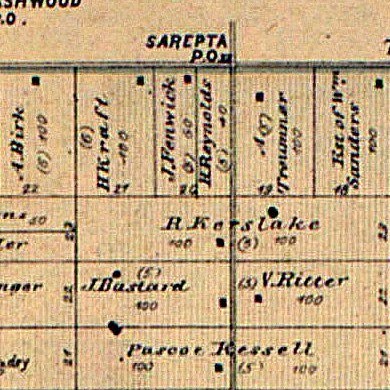
(below top) A view of the Sarepta corner on the Hay Township side, from Huron County Historical Atlas published in 1879. (Bottom) The same intersection (Dashwood Road and Goshen Line) on the Stephen Township side of the boundary in 1879. During the early years, properties around the Sarepta corner frequently changed hands. North is up on both maps.

***********************************************
1862
“A tavern licence was granted to Mr. Reynolds on the Goshen corner, South Boundary (at Sarepta).”
extracted from “Hay Township Highlights: 150 years of Diversified Progress, 1846 – 1996”, published by the Hay Township Book Committee under the auspices of Hay Township Council, Alice Gibb ed.; pg. 39 ISBN : 0-919939-43-0
***********************************************
“At the next corner is Sarepta, another biblical name. The original Sarepta was an ancient town in southwest Syria. We can only wonder how this corner in Stephen came to be named for it. A frame Methodist church, known as Salem, once stood just east of the Sarepta corner but it is not known when it was built or how long it remained in use.
In the early 1860s residents at Sarepta were;
on the Hay side:
Lot 19 James Balkwill
Lot 20 Christian Haist
on the Stephen side:
Lot 19 Isaac Wedlock
Lot 20 Francis Burns
Lot 21 Adam Bastard
Lot 23 Richard Whiting
Lot 24 William Toine
From Lot 25 west to 35 the land had not been taken up on either side of the boundary.
Mr. Christian Haist sold a half acre lot on the southwest corner of his farm to William Reynolds, who built a log house with a barn at the rear. Twice a week, Mr. Reynolds rode the six miles in to Exeter to pick up the mail. He finally applied for a post office at the corner and his application was granted. The Sarepta Post Office was opened on March 1, 1865 with William Reynolds as postmaster. It was said that he received the appointment in recognition of his services during the Crimean War. The post office was closed for over four years in the early 1880s but later reopened and operated until May 1914. In that time there were only two postmasters, Mr. Reynolds and his son Horatio.
Mr. Reynolds also built a fine two story brick hotel at the Sarepta corner. The building was 34 feet by 44 feet, with a veranda all across the front and inch thick maple boards on the floors upstairs and down. The veranda was later removed when it interfered with the growth of trees. The hotel was first known as the Farmer’s Inn and, later, as the Sarepta Hotel. The west part of the building served as a store and post office.
William Reynolds was an interesting personality. Besides serving his country during the war, he had the honour of playing his flute at Queen Victoria’s coronation. The instrument on which he played became a prized family possession. No doubt he had many interesting stories to relate to travellers who broke their journeys at Sarepta.
Other businessmen listed at Sarepta were Christian Haist, a cabinet maker, Conrad Pfaff, a blacksmith [ed. note: Pfaff is at Sarepta in 1869, but later moves to Dashwood.], Joseph Martin, a shoemaker, Philip Schweitzer, a carpenter, Joseph Schapp, a wagon maker, and William Simpson, a tavern keeper. John Ewing was a general merchant in 1869. Reverend J. Cheetham had charge of the Primitive Methodist Church [sic]. J. Broderick and J. Rollings were listed as teachers, possibly at the school at Sharon.
After the hotel closed, Horatio Reynolds operated a seed business for a number of years. When Reynolds retired to London in 1939, Everett Haist purchased the property and operated a McColl Frontenac Agency [petroleum]. The next owner was Robert Spicer who used the building as a residence. Finally, it was sold to Norman Cowan who remodelled the east part and opened a lunchroom. The Department of Highways purchased the building and in 1958, removed it to ‘daylight’ the corner. Mr. Cowan erected a restaurant and service station on the southwest corner at Sarepta. When it burned down, the business era in Sarepta was over.”
(below) Cowan’s Lunch on the northwest corner of Dashwood Road and Goshen Line in the 1950s. The building was torn down in 1958.

Image and text extracted from “The History of Stephen Township”, by Susan Muriel Mack, 1992; pgs. 225-227
****************************************
“More Bible Christian churches followed. Three new churches were dedicated in 1869. These were: Salem, a frame church on the bypass south of Centralia; Sharon, a frame church five miles west of Exeter; and a white brick church at Centralia. Some time after 1870 a small church was erected east of Sarepta.”
extracted from “The History of Stephen Township”, by Susan Muriel Mack, 1992; pg. 256