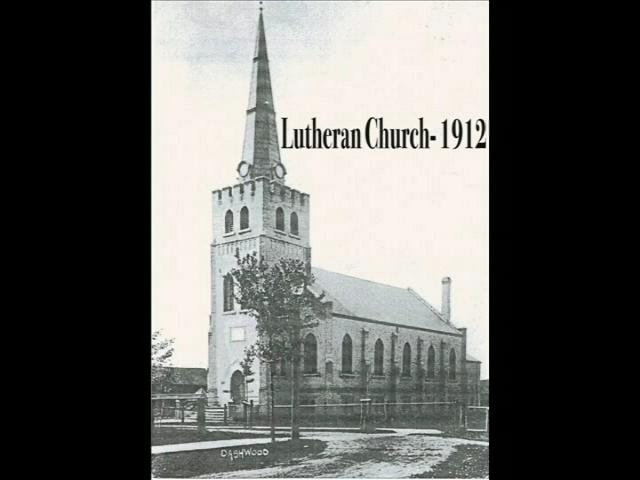
(below) Zion Lutheran Church building, built in 1908 to replace the original frame construction church on the site. This building was completely destroyed by fire on April 5, 1979.
(below) Zion Lutheran Church building, constructed in 1980 to replace the previous church lost to fire in 1979 on the same site.
http://maps.google.ca/maps?f=q&source=embed&hl=en&geocode=&q=dashwood+ontario&aq=&sll=49.891235,-97.15369&sspn=40.827873,79.013672&ie=UTF8&hq=&hnear=Dashwood,+Huron+County,+Ontario&t=h&layer=c&cbll=43.348022,-81.634715&panoid=5AyJJXjEx9OW3_Je00FQRw&cbp=13,354.91,,0,4.56&ll=43.340536,-81.632152&spn=0.014982,0.036478&z=14&output=svembed
View Larger Map
“The Lutheran pioneers built small log houses as places of worship. The Rev. I. Meunzinger was called to serve and he organized a Lutheran congregation on the Bronson Line on the site of the present Lutheran Cemetery. This was known as St. John’s Evangelical. The exact date is not known but the land for the use of the church and for burial purposes was donated by the pioneer Walper family. A building was in existence as early as 1864.
On April 14, 1873, Dashwood congregation was granted the right to form their own congregation. In the minutes of 1873 a congregational meeting was held August 10 at which time St. John’s congregation commissioned the trustees to sell its property for $40 and disband. [Ed. note: $40 in 1873 is the equivalent in today’s funds of roughly $750.] Immediately the first Evangelical Lutheran Zion’s congregation was organized.
The new trustees, Louis Walper, Jacob Kuntz and Lounz (sic) Decher were elected and installed. The trustees were authorized to buy the church property from the trustees of St. John’s for $40. Plans were made to build a church in Friedsburg (Dashwood) and in 1874 a frame church was opened at a cost of $1150. The parsonage next door was also purchased. Part of this church is part of John Becker’s barn.
In 1896 anew parsonage was built. On October 13, 1907, a building committee was appointed for a new church, namely Henry Willert, Henry Kraft, Otto Miller, George Kock and Caspar Walper. In January, 1908, members drew the bricks from Crediton with teams and sleighs. The contract for the masonry work was let to Louis Schumacher and the factory work material to Dashwood Planing Co. Sunday, May 31, [1908] the cornerstone was laid by the pastor, Rev. G. Thun assisted by Mr. Schumacher and Henry Kraft. December 13, 1908, the new church was opened. Members of the board were Jacob Schroeder, Otto Miller, Henry Neuschwanger and Fred Willert.
The first recorded baptism was Louise Elizabeth (Mrs. Charles Keller) daughter of Mr. and Mrs. Christopher Miller. The first recorded wedding, Jacob Roeder and Katherine Restemier (sic), Jan. 20, 1874 (sic).
Ministerial sons of the congregation, George Schroeder, Louis Walper, Emil Schroeder, Ernes[t] Mueller, Rudolph Eifert, Oscar Graupner and Arthur Rader.
Twenty pastors have served the Lutherans from 1873-1985, Rev. I. Muenzinger, Rev. I. Ehinger, Rev. G. Sagehorn, Rev. D. Schall, Rev. A. Rehn, Rev. D. Graef, Rev. J. Himmler, Rev. F. Schroeder, Rev. R. Eifert, Rev. G. Thun, Rev. P.G. Graupner, Rev. E. Bruer, Rev. N. Ness, Rev. T. Luft, Rev. L. Hignell, Rev. K. Zorn, Rev. W. Gatz, Rev. E. Steinman, Rev. F. Morgret and Rev. M. Mellecke.
A severe electrical and snow storm swept the area April 5, 1979 and the church burned, apparently struck by lightning. Members of Zion Lutheran Church, the community and former members as well as those who were familiar with the church were stunned by the loss of such a beautiful structure. The fine job done by the many fire departments in preventing further loss of buildings was commendable. The use of Calvary United Church as a place of worship shows that Christianity is the still the backbone of this community.
A building committee of eleven members were appointed by the nominating committee. These were Howard Datars, Chairman; Bill Becker, Harry Hayter, Pastor Mellecke, Ron Merner, Mrs. Ray Rader, Mrs. Delmar Miller, Hubert Miller, Dave Rader, Alphonse Denomme and Emil Becker. It was decided to restore if possible anything that was recovered following the fire. The church shed was sold to make room for the parking lot. The building committee met with architects and proposed the construction of a church to seat 200 people with accommodations for 50 more in an overflow area that could be used for other purposes.
The choir would be seated in the gallery where the organ would be located. Christian education space for 100 Sunday School children was proposed. Included also were plans for other facilities, including a kitchen, a room for young people, a general office, a study and storage space.
A campaign for pledges to finance construction of the church was launched in November, 1979. The congregation was heartened by voluntary donations totalling $29,000 from church members, about 20 other Ontario District congregations, three Lutheran congregations in the United States and Ailsa Craig Presbyterian Church. Some of the gifts were gathered by local branches of the Lutheran Life Insurance Society. The society provided matching gifts up to $1000 [,] where several branches worked together. For example, branches in the Kitchener-Waterloo area raised $4,827 [,] to which the society added $1000.
Of the seven bids received, the building committee awarded the contract for construction of a new church to the Bratt Construction Co. of Hyde Park. Seven bids were received (sic). There was great excitement Sunday, April 20 [1980] at the site of Zion Lutheran church, as the old corner stone was opened. Time had taken its toll. The books which were mostly German were very fragile. There were also a few coins.
A ground breaking service was held at Zion church April 20, 1980, to mark the start of a new church. Rev. Marvin Barz, Goderich was the Guest Speaker. It was a happy occasion. The building committee had driven many miles looking at churches. Finally after months of hard work the outside work on the new church was nearly completed and on Sunday, September 28, 1980 it was time to lay the cornerstone. District president, A. Stanfel spoke at the morning service at the United church then all walked to the Lutheran church where the cornerstone was laid by Rev. Mellecke, assisted by Howard Datars. Behind the cornerstone was placed the box of Remembrance. It was made of one-eighth inch stainless steel manufactured and donated by Nuhn Industries of Wartburg, [i]t is welded and sealed with a silicone sealant.
In the box were the 1908 coins, 1908 Lutheran Annual, Bible, hymnal, catechism, 1980 Lutheran Annual, 1980 coins, 1979 congregational reports, list of present officers, 1979 copy of [the] Times Advocate, [a] picture of the old church, Anniversary observances, 85th anniversary of the congregation, 50th anniversary of [the] old church [from] August 1958, bulletin for July 22, 1973 (centennial observance Sunday), a list of Ladies Aid members, “Grace and [B]lessing” a history of the Ontario District Lutheran church – Missouri Synod written on the 75th anniversary of the District, a LCMS Statistical Year Book, and copies of the treasurer’s Financial Statement when the old church was built and the Dedication of the old church December 13, 1908.
On Wednesday March 4, 1981 the [L]utherans moved into a beautiful new but very different church. It had taken many hours of planning and work for the building committee and other members. Yes there was a fine pipe organ from First Lutheran Church, Windsor. On Sunday, March 8, several officials from Zion Lutheran church attended the morning service at Calvary United Church and Ron Merner, president of the congregation returned the keys to Rev. Barbara Laing, thanking her for the use of their church.
Sunday, June 21, was [the] dedication of the new church. It was a glorious day. Overflow crowds at both morning and afternoon services were able to watch and hear the service on closed circuit TV. Former members and friends were able to relax indoors or out and enjoy cafeteria style meals served by the Ladies Aid and many willing hands from the congregation. Donations of food, money, time and help were tremendous. The church bell which had been silent since April 5, 1979 was mounted on a tractor and summoned all to worship, brought back memories both sad and joyful to all present. Guest speakers were Dr. R. Sauer, vice-president, Lutheran Church, Missouri Synod and Rev. Arthur Rader, a son of the congregation. Former ministers who attended were Rev. K. Zorn, Kitchener, Rev. W. Gatz, Jackson Mich., Rev. F. Morgret, Beamsville and Rev. Earl Steinman, Parkhill.
Also in attendence were two widows of former ministers, Mrs. T. Luft, widow of Rev. T. Luft, Kitchener; and Mrs. L. Higinell, widow of Rev. L. Higinell, St. Catherines and Rev. M. Barz, Goderich as well as area pastors. Judging by Monday’s weather which was wet and cold, the good Lord has smiled His approval with all that lovely sunshine. The bell, cast by a firm in St. Louis, Mo., bears a biblical inscription e[n]dearment: “Kommt! Es ist alles bereit” (come! all things are ready).
We have a tower made of steel by Emil Becker of Dashwood. The old bell is in the tower and once gain summons everyone for worship. It also announces a death. I took pictures to show the process of its development. Everyone is pleased to hear it again. The first Sunday was September 19, 1982.”
extracted from “Friedsburg-Dashwood 1860-1985” by Mary (Patterson) Rader, 1985; pgs. 16-21, ISBN 0-9692115-0-3
*************************************
“The first church in Friedsburgh (sic) was built by the Lutheran congregation in 1874, on the Hay Township side of the village. The frame structure replaced an earlier church located on the Bronson Line near Dashwood, on land donated by the Walper family.
The frame church was built for $1,150 and it served until 1907 when the congregation decided to rebuild. The new brick Zion Lutheran Church, with its impressive tower and tall steeple, was dedicated in December 1908. German language services continued in the church until 1940. The Lutheran church was destroyed by fire on April 5, 1979. A new church, featuring a very contemporary steeple design, was opened on June 21, 1981.”
extracted from “The History of Stephen Township”, by Susan Muriel Mack, 1992; pg. 273
*************************************
“Canada District Founding Congregations”
“Among the congregations joining together to form the Canada District in 1879 were Zion Lutheran, Dashwood, First Lutheran, Logan, and Second St. John’s Lutheran, Wartburg. They are featured in the continuing series on the founding congregations in articles by District archivist Carol Nagel, compiled from various sources, including Grace and Blessing, edited by President Frank Malinsky and published on the occasion of the District’s 75th anniversary.
Zion Lutheran Church, [Da]shwood, Ontario
“Lutheran families from various parts of Europe settled in and around Dashwood about 1850. As early as 1858, the need for spiritual care resulted in the building of simple log houses for worship whenever a pastor was available. Like many settlers of the early days, they were deceived by “itinerant preachers who were lovers of earthly gain but not of doctrine and orthodox practice.” When, in 1861, a congregation was organized in Zurich known as St. Peter’s German Evangelical Lutheran and Reformed Church, the settlers at Dashwood constituted part of its membership. The difficulty of traveling there by foot, on horseback or by oxcart over corduroy trails made them determined, with God’s help, to organize their own congregation.
Rev. I. Muenzinger served St. Peter’s congregation and also organized the Lutheran congregation on the Bronson Line near Dashwood, known as St. John’s Evangelical Lutheran Church. The land on which the church was built was donated by the pioneer Walper family and is the site of the present Zion Lutheran Cemetery. The exact date of the erection of the church is unknown but the building was in existence as early as 1864. Rev. Muenzinger was followed by Rev. I. Ehinger, Rev. G. Sagehorn, Rev. D. Schall and Rev. A. Rehn who served at Zurich and on the Bronson Line until 1873. On April 14, 1873, the members of St. John’s, who for some time had felt that they wished to become a separate organization with the right to call their own pastor, withdrew from the Zurich congregation.
A member of St. John’s contacted Rev. Ernst of Elmira in regard to the spiritual care of the congregation. At the request of Pastor Ernst, Rev. Succop of Seebach’s Hill presented a constitution for discussion and assisted the congregation in calling its first pastor, a candidate from the seminary in St. Louis, Rev. Daniel Graef (1873-1875). On August 10, 1873, the congregation commissioned its trustees to sell its property for $40 and then disband.
Immediately, the first German Evangelical Lutheran Zion Congregation in Hay Township, Huron County, was organized and the constitution was signed by the members. Three new trustees were elected, immediately installed and, by unanimous resolution, authorized to buy the church property, including the cemetery, from the trustees of St. John’s congregation for the above-mentioned sum of $40. Late in 1874, a frame church was built in the village of Friedsburg, as Dashwood was called at that time, at a cost of $1,150. Prior to the dedication of this church, a house next to the church property was purchased to serve as a parsonage.
Rev. John Himmler (1875-1880) succeeded Pastor Graef and, during his pastorate, the congregation officially became a member of the Lutheran Church–Missouri Synod in 1880. Also in 1880, the first school house for instruction of the children was built in which Pastor Himmler organized a Saturday school and also conducted his confirmation classes. Sunday school had been mentioned in the minutes as early as 1876. Later in 1880 Pastor Himmler accepted a call to Michigan.
Due to a scarcity of pastors, it wasn’t until 1881 that a student pastor, Friedrich Schroeder (1881-1886), was assigned to the growing congregation and arrangements were made to have him continue his studies privately under the direction of the district officials. Upon the satisfactory completion of his studies, he became the regular pastor of the congregation and continued until 1886 when he accepted a call to Port Huron, Michigan. During his pastorate, the first organ was purchased for use in the church.
In 1887, Rev. Reinhart Eifert (1887-1906) of Pembroke was inducted into office and remained pastor of Zion for 19 years, during which time membership increased through the arrival of more settlers and continued development of the Dashwood area. The congregation replaced the school house with a new brick building in 1888 and, in 1896, granted the sum of $1200 to build a new parsonage. In 1898, the Ontario District Convention was held in Dashwood for the first time. For this event, pastors came to Exeter or Parkhill by train and were met there by members of the congregation with horse and wagon or with the popular “democrat” which was considered the height of luxury in those days.
When Pastor Eifert accepted a call to Floradale in 1906, Rev. Gustav Thun (1906-1913) was called. At this time, many members felt that, since God had richly blessed them in this land, the time had come to build a new house of worship. In January 1907 the decision was made to build and to spread contributions to the building fund over five years. In January 1908, members of the congregation began to bring the bricks for their church from Crediton with teams and sleighs. The new brick church building, at a cost of around $10,000, was dedicated on December 13, 1908. Overflow crowds attended each of the three services during the day and, in the evening, many were turned away, unable to gain entrance.
Rev. Paul K. Graupner (1913- 1924) of Elmira followed Pastor Thun who accepted a call to Napoleon, Ohio. In 1922, hydro was installed in the church and parsonage. When Pastor Graupner resigned, the congregation called Rev. Egmond Bruer (1924-1927) of Wartburg to be their pastor. During his pastorate in 1925 a pipe organ was dedicated and regular evening services in English were begun. In 1927, Pastor Bruer resigned and Rev. William Ness (1928-1933) of Logan was called as pastor of Zion.
Rev. Ernst G. Mueller, a son of the congregation, was ordained on July 15, 1928 before leaving to serve as missionary among the Negroes in Cleveland, Ohio. Rev. Theodore Luft (1933-1946) of Pembroke was installed as pastor after Pastor Ness resigned. In 1935 the constitution was translated into English. German services were discontinued commencing May 26, 1940. In 1945, a furnace and bathroom were installed in the parsonage and, in 1946, altar brassware was dedicated as a memorial to members of the congregation who served in World War II.
When Pastor Luft accepted a call to Hanover in 1946, Rev. Louis F. J. Higenell (1946-1956) was installed as pastor. The 75th anniversary of the congregation and 40th anniversary of the church building were celebrated in 1948. In 1952, storm windows were installed in the church, a new piano was purchased for use in the church, and the cemetery was enlarged and improved. Regular evening services were discontinued in 1953. Washroom facilities were installed in the basement of the church in 1954. In 1956 Pastor Higenell resigned and Candidate Kenneth L. Zorn (1956-1960) of Oakshella, Saskatchewan, was ordained and installed as pastor of Zion.
Also in 1956, the first memorial cemetery service and decoration day was observed. The first Vacation Bible School was held in 1957 and, in 1958, a resolution was passed to contribute $100 a year to any member of the congregation who entered one of the Lutheran preparatory schools for fulltime service in the church.
Other pastors who have served Zion Lutheran Church in Dashwood are Rev. William A. Gatz (1961-1966), Rev. Earl E. Steinman (1967-1972), Rev. Frank Morgret (1972-1975), Rev. Mayo Mellecke (1976-1986) and Rev. Larry Stojkovic (1987-1995). The 100th anniversary was celebrated with a service on July 22, 1973, at which the Rev. Ernst G. Mueller, a son of the congregation, preached.
During the evening of April 5, 1979, lightning struck just north of the tower of the church on a very stormy night with rain, sleet, snow, lightning and high winds. Under those conditions, it was impossible to save the building or any of its contents and everything was destroyed. Immediately offers of help were received, including available worship facilities. The decision was made to rebuild and, on June 21, 1981, the new building was dedicated. Zion Lutheran Church in Dashwood consists of 333 communicant members. Rev John E. Trembulak III, has been the pastor since 1995.”
Source: Lutherisches Volksblatt, Autumn 2005 pgs. 4-5. Link is to a PDF document.