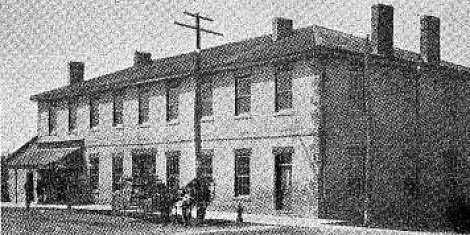
(below) The Walper Hotel, once situated on the southwest corner of what is today the intersection of Dashwood Road and Highway #4 in the north part of the community of Exeter, was a popular; but occasionally rowdy, stopping point for thirsty farmers, mill workers and travellers making their way along the Dashwood Road.
(below) The same location today.
“[The] Walper Hotel was on the corner of the Lake Road and the London Road where the Guenther Tuckey lot is now located.”
extracted from “Exeter, Situate on the London & Goderich Road in the township of Stephen and Usborne, 30 miles from London and in the County of Huron, C.W. : a history of Exeter, Ontario” by Joseph L. Wooden, Exeter, Ont.: R. Southcott, 1973, pg. 85
**************************************
“[The Walper Hotel] was a large building in Francistown [Ed. note: Francistown was the original name for the small community surrounding the intersection of Dashwood Road and Highway #4.] and operated under various names, the Exeter North Hotel, The Exeter North Temperance House and the Francistown Hotel. It was operated in the late 1860’s and early 1870’s by James Towers. Abel Walper acquired it and then in 1877 sold it to H. Martin. In the 1860’s the hotel was considered one of the finest in the country. It had been erected in the early 1850’s possibly by Matthew Rogers. In the 1860’s it was operated by James Towers as the Francistown Hotel. Walper probably bought it from Towers. Walper in 1877 went to Berlin (Kitchener) and evidently had something to do with the construction of Kitchener’s now famous Walper House. [Ed. note: Abel Walper built the “high class” four story Walper Hotel in Kitchener Ontario in 1893 at a cost of $75,000; if this figure is correct, it is the impressive economic equivalent of several millions of dollars in today’s funds.]
The hotel was across the Lake Road from Fenwick’s Mill and drew trade from the farmers coming into the mill with their grain. George Fenwick, a son of the mill owner, told the following stories about the Walper Hotel. On the occasion of the Fenwick’s arrival in Exeter from Zurich one of the Fenwick children pointed to the imposing structure and asked:
‘What’s over there, Mother?’
‘That’s a den of iniquity and I want you boys to keep away from there,’ replied Mother.
‘What’s a den of inickety?’ [sic] asked the boy.
‘It’s a terrible place where they drink that terrible whiskey and fight – so never go near the place’, was Mrs. Fenwick’s ominous warning.
But boys being boys, young George did go into Walper’s saloon. Young George had acquired a cheese sandwich from the bar and Mr. Walper handed him a mug of beer saying, ‘Here sonny, take this and quench your thirst.’ ‘I don’t want your old whiskey’, was the reply. ‘Whiskey, ho, ho, ha, ha, why that’s good old lager beer’, Walper told the boy. Fenwick no doubt recalling his mother’s warning was about to pour the contents of the mug on the floor when a hand shot out and snatched the glass, ‘No you don’t, sonny’, and a gnarled old farmer drained the mug.
The Walper Hotel had a reputation for being a wild place. It was referred to as a ‘noisy saloon’. The [Exeter] Times carried an item in 1873 which illustrated the noisy nature of the saloon. It seemed that ‘a couple of navvies who had been away with the volunteers’, stopped in at the hotel. They eventually became drunk and noisy and started fighting. During the fight ‘one of them named McDonald had his nose bitten off by Bruce Brownlee’. Dr. Morden tried to repair the ‘hanging flesh and bone’.
Attached to the south end of the hotel was the store operated by Trick and Currelly. Thomas Currelly had come to Exeter some time in the 1860’s or early 1870’s. Currelly’s wife was a Treble whose family had come from Devonshire. Currelly’s son, Charles T. Currelly became the first curator of the Royal Ontario Museum and a world renowned archaeologist. In his book ‘I Brought The Ages Home’, Currrelly has the following harsh words about Exeter’s hotels:
‘There were four hotels where the board was three dollars a week, or a dollar a day for transients, and where the main living was made by selling beer and whiskey. The hotel keepers were socially outside the pale and, I think, deservedly because a more contemptible crowd it was hard to find. The wholesale liquor people who did business with them said theirs was the hardest, meanest trade it was possible to imagine. A few loafers hung around the hotels, and the only time I ever saw a man horsewhipped was when an old, lame, enormously fat hotel keeper horsewhipped a strong young man. Though I was only five or six years old, I can remember this young man crying while the big horsewhip came down rhythmically across his back and legs.’
Currelly is being overly harsh and is no doubt using the one hotel to make an unwarranted generalization. The hotel he talks about is most surely the Walper Hotel since the young Currelly would not likely be wandering from Francistown a mile or more to the site of the other hotels. Who the fat hotel keeper was is difficult to say. Abel Walper sold out to Martin in 1877 and Martin sold to L.W. Gudwig in 1884. Gudwig had plans to erect a brewery on Fenwick’s property and since he was manager of Carling’s Lager Beer Department he knew the business. However, this industry did not develop. Later on another Walper operated the hotel. In 1892 the hotel was renovated and painted.
[…]
As the nineteenth century came to a close, the Exeter North Hotel ceased to be the wild noisy establishment that it was for thirty years and became a Temperance House first under Leonard McTaggart’s ownership and then John Morley’s. It was eventually sold to George Armstrong who tore part of it down. Les Gibson tore the rest of the building down when he erected a service staion on the corner.
It was in the Walper Hotel that Lancelot Hardy, a long time Reeve of the village, scared a poor tramp half to death. Hardy and his cronies were sitting around the saloon when some fellows dragged the tramp before Hardy’s table. Hardy held a mock court and ordered the tramp on pain of tar and feathers, never to set foot in Exeter again. The tramp was last seen running north towards Rodgerville as fast as he could run.
The Walper Hotel, then, provided a colourful chapter in the history of Exeter. One comment should be added to Currelly’s view that the hotel keepers were some kind of monsters. It is clear that in Exeter this was not generally true. Hotel keepers like Oke, Acheson, Hawkshaw, Leathorn, and others were among Exeter’s leading citizens and not in the least deserving of Currelly’s condemnation.”
Image and text extracted from “Exeter, Situate on the London & Goderich Road in the township of Stephen and Usborne, 30 miles from London and in the County of Huron, C.W. : a history of Exeter, Ontario” by Joseph L. Wooden, Exeter, Ont.: R. Southcott, 1973, pgs. 85-88
*******************************************
“The year Peter Deichert arrived in Hay Township is unknown. His two sisters, however, married area residents. Elizabeth married Louis Kraft of Stephen Township in 1853. Catherine wed Abel Walper of Hay Township, in 1856. Abel Walper is listed as a tanner in the Huron County Gazetteer of 1869: ‘The extensive tannery of Walper & Co., who turn out all kinds of sole, harness, and upper leathers, kipps, and calf skins, employ ten hands and a fifteen horse power steam engine. Their buildings are extensive and built of brick and wood.’ Abel Walper later operated the Prang Hotel, now the Dominion Hotel [in Zurich]. In 1893, he took his family of six children (two children had died previously) to Berlin (Kitchener) where he built the Walper House in 1893.”
extracted from “Hay Township Highlights: 150 years of Diversified Progress, 1846 – 1996”, published by the Hay Township Book Committee under the auspices of Hay Township Council, Alice Gibb ed.; pg. 30 ISBN : 0-919939-43-0