(below) Former site of the Sodom sawmill, owned and operated by twin brothers Samuel and Silas Stanlake. The former site of U.S.S. #13 Hay and Stephen, Sodom School, is located approximately 400 metres east along Dashwood Road, on the north side; just east of the Ausable River.
http://maps.google.ca/maps?f=q&source=embed&hl=en&geocode=&q=Dashwood+Ontario&aq=&sll=49.891235,-97.15369&sspn=39.184571,79.013672&ie=UTF8&hq=&hnear=Dashwood,+Huron+County,+Ontario&t=h&layer=c&cbll=43.35531,-81.544136&panoid=pNzrUi7tTFORXteJOo9dyg&cbp=13,148.52,,0,0.11&ll=43.351022,-81.544175&spn=0.014979,0.036478&z=14&output=svembed
View Larger Map
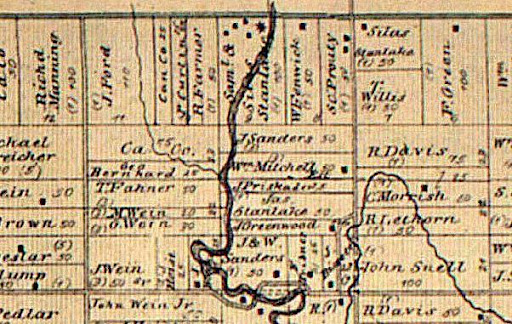
(below) North is up on this map. The square block of land featured in the image is bounded today by Dashwood Road (to the north), Ausable Line (to the east), Huron Street (to the south) and Parr Line (to the west). The former site of the Stanlake sawmill is located at the top centre of the image; the former location of the mill itself is indicated by an asterisk, immediately to the west of the Ausable River, adjacent to Dashwood Road. This map, extracted from the H. Belden & Co., 1879 historical atlas of Huron County, indicates apart from Stanlake’s mill, a steady level of development was occurring in the 1870’s at a locale south of the mill in proximity to a series of distinct bends in the Ausable River, near what is locally referred to as “Devil’s Elbow”; to the west of the modern day intersection of Huron Street and Ausable Line. With nearly a dozen structures in place in that immediate vicinity at the time, the budding development appeared well on its way to full village status. None of these buildings survive today. Click on image for a larger version.
“In the southern part of the Hay Swamp, around the junction of the Black Creek and Ausable River, there was a dense growth of elm, hemlock, cedar, soft maple, soft elm, pine and oak. Because of the soft swampy ground the road made a detour, following a small ridge. In 1873, Robert Bissett and Thomas Greenway built a sawmill in the area, unwittingly building it on the actual road allowance. [Ed. note: Thomas Greenway (March 25, 1838 – October 30, 1908) for whom the hamlet of Greenway Ontario was named, served as Reeve of Stephen Township from 1869-1875, (Muriel Mack pg.513) and later went on to become the 7th Premier of the Province of Manitoba.] Later, when the township put in a mile of corduroy road, the mill had to be moved to the Stephen side. In 1877, it was sold to Samuel and Silas Stanlake, twin brothers. William Carrick was the head sawyer and John Brown, foreman.
During the 1880s and 90s, the Stanlake mill built up a huge trade. Millions of feet of lumber were sawn and shipped far and near and hundreds of cords of tan bark were supplied to tanneries in Exeter, Clinton, London and other towns. The mill needed labour to keep up with the demand; at one time as many as 20 people were employed. because of the labourers’ heavy drinking, Chester Prouty, a retired school teacher, called the settlement Sodom. [Ed. note: Chester Prouty was the appointed Clerk of the Township of Stephen from 1858-1899. (Muriel Mack pg.514)]
Silas and Sam Stanlake were fond of singing and their voices were often heard during a drinking session. They were reputed to carry a ladder with them when taking a load of hay to town so they could get down easily each time they passed a tavern! A favourite expression of theirs was ‘We’ve made our money together and we spend it together.'”
extracted from “The History of Stephen Township”, by Susan Muriel Mack, 1992; pgs. 152-153
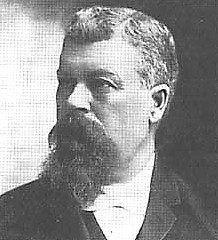
(below) Thomas Greenway, Premier of Manitoba, 1888-1900. (Provincial Archives of Manitoba via Muriel Mack pg. 369)
***********************************************************
“James and Ann Stanlake (Stanlik, Stanlick) emigrated from Devonshire, England to settle in Upper Canada. They built a log house in Stephen Township on 50 acres of land on S.E. corner Lot 18, Con. 4. [Ed. note: The Historical Atlas of Huron County shows a James Stanlake as owning 100 acres at Lot 18, Con. 2, Stephen Township in 1879.] Their eldest children were twins, Samuel and Silas Stanlake (1841-1912). Other children listed in the 1851 census were John (1843), Selina (1845), Mariett (1847) and Elloner (1850). In the 1861 census, Elloner’s name was listed as Ellen and two more children, Cedric (1854) and Margaret (1855) were added. Their religion was given as Methodist Bible Christian.
Samuel Stanlake bought the land nearby and then moved away, but Silas stayed on the 50 acres with his parents. Samuel’s son, Silas, suffered a tragic fire in June, 1923. His wife Maude Marie (Porter) and five of the Stanlake children died in their house at Sodom. Only the father Silas II, a son, Harry and an adopted daughter, Beatrice, survived. Silas I Stanlake married Elizabeth Parsons (1854-1913). They had two sons: Chester (1882) and Nelson (1885-1954). After his wife died, Silas married again and moved to Vitoria [sic], British Colombia. Chester married Louise Dearing, and moved to Stettler, Alberta. They had four children: Fred, Dorothy, Ruth, and Kenneth. Silas and Elizabeth’s second son, Nelson Stanlake bought a farm at Lot 6, SB, Hay. He married Laura Mcleod (d. 1954) of Ailsa Craig in 1909. Their children were: Elizabeth (1910-1983), Norman Silas (1911), Donald Grant (1916-1926), Lloyd nelson (1919) and Neil McLeod (1930).

(left) “The children of James and Ann Stanlake with twins Samuel and Silas in the front row. The other members of their family were: John, Selina, Mariett, Ellenor, Cedric and Margret. (one missing in photo).” Image source: “Hay Township Highlights: 150 years of Diversified Progress, 1846 – 1996”, pg. 625. Click on image for larger version.
After their marriage, Nelson and Laura lived two years in Exeter and then built a new home on Lot 2, Con. 2 [Hay?], where they resided until 1950. This farm was the home of the Stanlake Dairy. […]
extracted from “Hay Township Highlights: 150 years of Diversified Progress, 1846 – 1996”, published by the Hay Township Book Committee under the auspices of Hay Township Council, Alice Gibb ed.; pg. 625 ISBN : 0-919939-43-0
***********************************************************
“As in many new settlements, there was more than a little drinking and rowdiness amongst the Stanlake mill workers. For this reason, township clerk and retired teacher Chester Prouty, named the place Sodom, after the biblical city destroyed by ‘fire from Heaven’ for its wickedness.
But not all of Sodom’s inhabitants were cut from the same cloth. A small group of people held church services and Sunday School in their homes and had regular meetings with special speakers. In June 1896, the Royal Templars of Temperance held their District Council meeting, dinner and tea in Samuel Stanlake’s orchard, with 100 people in attendance. Public school inspector Elgin G. Tom of Goderich was the president of the organization. At that time, Sodom also had a Glee Club which provided entertainment at local gatherings.
In later years, when saw milling was no longer lucrative, the Stanlakes turned to farming. There were many tales told about the Stanlake brothers. One concerns a time when they were taking a loaded hay wagon into the barn. One twin was on the ground driving the horse and the other was on top of the wagon. As the wagon passed under the door of the barn, he hit his head against the door frame and fell to the ground stunned. He got up confusedly and rubbing his head said plaintively: ‘Be I Sile or be I Sam?’
extracted from “The History of Stephen Township”, by Susan Muriel Mack, 1992; pgs. 223-224
************************************************************
“Silas Stanlake, who lived west of Exeter, had a Russell car. The Russell Motor Car Company was established in Toronto by the inventor, Thomas Alexander Russell, a native of Usborne Township. The company operated from [1904] to 1916.”
extracted from “The History of Stephen Township”, by Susan Muriel Mack, 1992; pg. 54
************************************************************
“Despite the noble efforts of the churches, the lodges and the “cures” people still got drunk. Indeed, in the summer of 1884 a traveller noted that ‘Exeter was the worst town in Ontario for loafers and loiterers hanging around the hotels and saloons’. Also in that warm summer of 1884 much local interest was shown in what was referred to as:
‘The Drunken Frolic of the Sodomites’
Sodom a small community on the Lake Road had in the 1880’s a few houses, and the Stanlake Saw Mill. One warm and pleasant August evening “sweet songs” were heard by the passers by. Some of Stanlake’s men had been drinking all day ‘of course this was a continuance of their daily habits’. As the “whiskey frolic” continued a problem developed. By 9 p.m. the whiskey was all gone and, by God; the nearest whiskey was three miles away, presumably at the Walper Hotel. ‘The Stanlake brothers not having any extra fast horses were at a loss to know how to secure a fresh supply of whiskey in the quickest possible time’. One of the boys, ‘the fire of craving burning within’ made a bet he could run the three miles in fifteen minutes. Prior to his departure an eavesdropper heard the ‘sweet songs of Sodom’ in the night. In a letter to the ‘Times’, this eavesdropper said, ‘Let me give you a note or two: Sam, Sile…Sam, Sile; then in a little lower tune, Gillis…Gillis; more grog, more grog; whiskey all gone’.
Shortly after this the runner started out for Exeter; he was half-naked and certainly more than “half-stoned”. It is uncertain as to the final result of the run, history does not record his time if indeed, he made the distance at all. It was however, suggested in the “Times” that in future the Sodomites keep cool and if a ‘hasty trip is necessary again’ that a fast horse be taken rather than start out ‘a man half-naked.’ The writer went on to say:
‘Come all ye Sodomites and learn
from the outcome of that night’s frolic
not to touch, taste or handle the accursed stuff’.
Perhaps the Sodomites [took] this advice for the Sodom Temperance League was formed with Silas Stanlake Jr. as President. There is humour in such nocturnal adventures as the Sodom Whiskey Frolic but whiskey caused more tragic incidents as well. In the 1880’s the “Times” reported the following: ‘A man named George M. abused his wife and infant in the Hay Swamp and cut Edward H.’s head open to the eyebrows with an axe’. George was drunk when he did it.”
extracted from “Exeter, Situate on the London & Goderich Road in the township of Stephen and Usborne, 30 miles from London and in the County of Huron, C.W. : a history of Exeter, Ontario” by Joseph L. Wooden, Exeter, Ont.: R. Southcott, 1973, pgs. 94-95
**********************************************
“This memoir of life in the community of Sodom was written by Ethel (Isaac) Eagleson in her 85th year. ‘Sometime in the 1880’s, my mother and father moved from Usborne Township to the town line between Hay and Stephen Townships, to a farm in Hay Township, in a place known as Sodom.
I’m not sure when the small store in the district was turned into a public school, but the first teacher that I know of was Mr. Bell, and the school itself was called Sodom School. Then the next teacher I remember, was Miss Francis Scott of Delaware. She taught about two years and then married my first cousin, Andrew Isaac. The next teacher was Agnes Bailey, followed then by Miss Robertson, Miss Keefe and Miss Ferguson. My school days ended with Miss Ferguson. We had to go to Exeter to try entrance exams and that was about the end of our education, as very few went on to high school in Exeter.
The only business of any kind in Sodom, which gave work to quite a number of people, was the sawmill, owned and operated by Sam Stanlake. The sound of the whistle from the mill, in the a.m. and again at six o’clock p.m., was a cheerful sound. The workers used to peel the bark from the hemlock trees and take wagon loads (of the tan bark) to Clinton to the tannery. The workers used to take loads almost as large as a load of hay.
The roads, being gravel, and with no cars around, didn’t get any grading in the summer or winter. Naturally the snow kept building up and up. When it would thaw a little, the sleighs would cut down in places and make pitch holes which were not too pleasant to ride over, especially in the cutter. The highlights of those times, for me, were the school picnic at Grand Bend, and the Christmas concert at Sodom school. People came from miles around to the Sodom Christmas concert. The school served as a church on Sundays with Rev. Clarke as minister and Silas Stanlake as superintendent of the Sunday School. Then we also had Epworth League (meetings) on Sunday nights.
The following are the names of some of the families that attended the Sodom school. They were the Isaac Dunsford, Ching, Hooper, Green, Prouty, Stanlake, Carrick, Isaac, Smith, Stacey, Penhale and Ford families. The old school was torn down in 1905, and a nice one built, which served the community until shortly before consolidation, when the children around there had to go to Sharon and the Hay Township school’.”
extracted from “Hay Township Highlights: 150 years of Diversified Progress, 1846 – 1996”, published by the Hay Township Book Committee under the auspices of Hay Township Council, Alice Gibb ed.; pgs. 83-84 ISBN : 0-919939-43-0
**********************************************
Sodom Sunday School
“Sodom, named because of the rather rowdy actions of local mill workers, never built a church. Newspaper reports, however, describe a flourishing Sunday School, held in area homes. An Exeter Times correspondent reported, ‘Our Sunday School is doing well though it is to be regretted there are some of our citizens who are a little careless about attending.’ The same paper, on December 29, 1898, carried a description of a Christmas entertainment connected with the Sodom Sunday School.’ The program consisted of 51 numbers…Rev. Martin of Exeter occupied the chair. The teacher deserves a great deal of credit for the manner in which the children were trained, their part of the program being especially well carried out.”
extracted from “Hay Township Highlights: 150 years of Diversified Progress, 1846 – 1996”, published by the Hay Township Book Committee under the auspices of Hay Township Council, Alice Gibb ed.; pg. 158 ISBN : 0-919939-43-0
**********************************************
“One of the most tragic fires in the area occurred outside Exeter at Sodom in 1923 when Silas Stanlake’s house burned. In this fire, six persons died. This fire is described below in the words of the [Exeter] Advocate report:
‘A most disastrous fire occurred at the home of Silas Stanlake three miles west of Exeter on Friday night, about 11:30 o’clock, when in some manner his home caught fire after the family had retired, and his wife Maud Marie Porter, aged 38; his brother Albert Stanlake, aged 46 and four of his five children, Clarence, Audrey, aged 12; Charlie, aged 9; Wilfred, aged 4; and Arthur Gilbert, a babe of three weeks, were either suffocated or burned to death…Mr. Stanlake went downstairs, and was horrified to find the kitchen in flames. He immediately called to the family to get up and come downstairs, while he attempted to put out the fire by getting a fire extinguisher which hung in the kitchen. Immediately, however the main portion of the house burst into flames and it was impossible for Mr. Stanlake to get up the stairs to rescue those in the upper story…The remains were recovered and these were taken to the funeral parlours of Mr. M.E. Gardiner, Exeter from which place the funeral took place on Sunday afternoon, to the Exeter cemetery. The service was conducted by Rev. A.A. Trumper and a great many people gathered in the opera house to pay their last respects to the deceased. The cause of the fire still remains a mystery and probably always will.'”
extracted from “Exeter, Situate on the London & Goderich Road in the township of Stephen and Usborne, 30 miles from London and in the County of Huron, C.W. : a history of Exeter, Ontario” by Joseph L. Wooden, Exeter, Ont.: R. Southcott, 1973, pg. 253
“Six Die As Home Burns; Mother, Four Children and Brother Victims In Ontario”. New York Times, pg.14. June 3, 1923
*******************************************
“The Stanlake home was the scene of the worst tragedy ever to occur in the township. Silas Stanlake’s wife, four children and brother were killed when their house was destroyed by fire on June 3, 1923.
Part of the report from the Exeter Times follows:
‘Fire destroyed the home of Mr. Silas Stanlake on the Lake road and claimed as its victims six, in the persons of Mrs. Stanlake, 38; her four children, Clarence, six; Charlie, four; Wilfred two; and a baby not three weeks old; also Albert aged 45.
The fire started at the rear of the house cutting off that exit. The father could not get the front door open but he was able to break a window through which he, his eldest son Wilfred, 15, and an adopted daughter Beatrice Edwards, were able to escape.
All day Saturday and Sunday people for miles around visited the scene of the tragedy. The funeral was held on Sunday and never in the history of Exeter did such a crowd gather for a funeral. There were more cars than could reach from the cemetery to the funeral home.'”
extracted from “The History of Stephen Township”, by Susan Muriel Mack, 1992; pg. 224