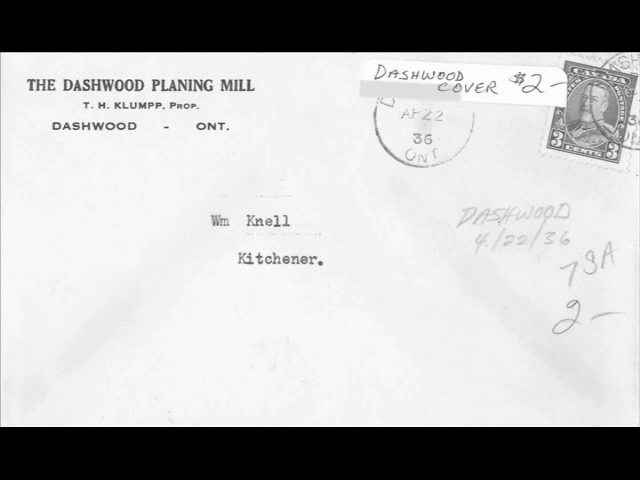
(below) In 1936, even if the person you were writing to resided in a “larger” community, you could still simply address a letter using only their name and reasonably expect that they would receive it. (Click on image for larger version)
“Dashwood Post Office was established December 1, 1871. The following have served their term of office [as postmasters]: Noah Fried, 1871 to April 4, 1888; Joseph Snell, June 1, 1888 to September 23, 1905; Jacob Kellerman, September 16, 1905 to February 10, 1912; Henry Willert, February 26, 1912 to July 14, 1922; Earl Guenther, April 2, 1923 to January 24, 1966; Donna Restemayer (Mrs. Leeland Restemayer), January 26, 1966 to -. It is believed that the post office known as Dash P.O. changed the name from Friedsburg to Dashwood. (Ed. note: There is no actual consensus on where the name “Dashwood” came from.]
The first Post Office was on the east side of Noah Fried’s house. This house was later owned by the Charles Guenther family. The Post Office went by what party was in office. Kellerman had it where Nicholson’s house stands. Joe Snell had it also where Lloyd Guenther’s house stands. (Ed. note: The post office was attached to the south end of the home and is still standing.] Henry Willert had it in the lower east side of the Gulen’s building. Jake Kellerman had it again then Earl Guenther moved it to the old post office site. Prior to moving it to the Boyle complex it was in a trailer beside the community centre.
extracted from “Friedsburg-Dashwood 1860-1985” by Mary (Patterson) Rader, 1985; pg. 37, ISBN 0-9692115-0-3
****************************************
“Peter McIsaac started the livery business. He had a mail route to Parkhill. August Tone had a mail route to Exeter. He built a livery barn where Ivan Grigg lives. McIsaac bought out Tone. He built the barn where the buses were kept. He sold the livery business to Henry Guenther.”
Monday, March 30, 1913 marked the final taking of the Guenther stage by Arthur Willert. For five years, he took the stage daily to Parkhill, calling at Khiva, Mt. Carmel, Leury, Moray and Parkhill post offices. He took up farming. Earl R. Guenther is a white-haired, bright eyed, lively man with a phenomenal memory. His father, Henry Guenther, had bought the livery business at the end of 1899, shortly before Earl’s fifth birthday. He began spending time with the horses and wagons.
He finished public school but never went to high school. Earl said he learned more out than he ever would in school, ‘I was more for out driving horses. I drove since I was six years old.’ On July 1, 1910, he carried his first mail bag, driving the regular Dashwood to Parkhill stage route when the regular driver took the day off to take his girlfriend to holiday celebrations at Grand Bend. In 1912 he began working regularly for his father on that route, running passengers, mail and freight between Dashwood and Parkhill until September 30, 1913. His father was killed April 22, 1913 when a team of horses ran away and crashed into a pole. His mother [Jane] ran the business and he went on the Exeter – Dashwood – Grand Bend route hauling freight, mail and passengers.
He went overseas in early 1918 to fight with the 3rd division, 8th Battalion, Canadian Engineers, and was in the front lines during the last six weeks of the First World War. He came home March 31, 1919 and two weeks later bought out his mother and started his own business. He received about a dozen horses and six or eight rigs in the purchase. His father had bought a couple of trucks in 1910 and 1911 but his mother had disposed of them while he was overseas. In 1919 he bought ‘a little Ford truck’ to carry mail and passengers on the Exeter to Grand Bend stage line. In 1922 he bought an International stake truck and started to operate a transport service to London, and in 1924 he began a regular run to Toronto. ‘It was a nine hour at one time. You didn’t have the roads like you have now and trucks didn’t go as fast either’ he said.
‘The business kept building up, getting bigger and bigger until we had 21 pieces of equipment.’ In 1944 he started busing students to South Huron District High School in Exeter, starting with one bus, then two years later took in Stephen, Hay and Usborne and had six buses. He drove one of them. During this time he was also Dashwood’s postmaster, a job he started in 1923.
On October 1, 1952, he sold his transport business to Ben Tuckey of Exeter, who also had a transport line. It was known as Guenther-Tuckey. His bus business continued to flourish and eventually there were 21 buses operating over 17 routes. In 1968, he sold the bus operat[ion] to Charterways Co. Ltd. of London but stayed on for some time as manager and driver. Since turning 65 he had to take a driving test every year because he was operating a school bus. In 1973 he drove a 72 passenger bus.
He retired from the postmaster’s job in 1966 after 43 years and now he is left with the mail contract route. Each morning he drives to the Exeter post office to meet the mail truck from London. Then he delivers the mail to the post offices at Hay, Kippen, Hensall, Zurich, Dashwood, Grand Bend and Crediton. Each evening he reverses the procedure taking mail from each of the smaller centres to Exeter. He also delivers the R.R. 1, Hay mail route on his way back to Dashwood from Exeter each morning. In 1980, at the age of 84, post office management officials held a ceremony in Exeter to mark his 70 years in public service. A gold chained vest watch keeps Guenther’s van on time, he checks it regularly and is never disappointed.
A grandson, Jim Guenther now has the route, he started in September 1980. Since 1980, Mr. Guenther is quite content to let his daughter, Shirley Kipfer do the driving but he is right there. They go as far as Hay P.O., servicing 40 boxes, in a light green Volkswagen van. At 89, Mr. Guenther is an alert man with memories that are tremendous.”
extracted from “Friedsburg-Dashwood 1860-1985” by Mary (Patterson) Rader, 1985; pgs. 66-67, ISBN 0-9692115-0-3
****************************************
“In 1946 Henry Hoffman retired following 45 years service with the Royal Mail at the age of 71. He said he would have quit sooner but thought he should wait until the war was over. As he sat in the old stage coach resting in his backyard he recalled how he had hugged the driver’s seat while his spirited team bounced the passengers and mail carrying stage over the rutted roads to Exeter and Grand Bend.
The retired mail carrier will have plenty of memories to think about as he sits in his neat brick bungalow or watches the new mailman deliver his bags from a perch in the garage of Earl Guenther, his old employer. Henry can take you all the way back to 1901 when he first began carrying the mail, expresses and passengers for the late Henry Guenther. He recalled the spring seasons when his team often splashed through water as high as their bodies on flooded roads between Dashwood and Exeter, but come what may the mail always went through.
In those days when stage coaches offered tempting prizes for the lawless, Henry packed a revolver but never had to use it. Mr. Hoffman marched hand in hand with progress. He exchanged his stage for ‘one of those new fangled autos’ in 1909. Country residents turned out along the way to watch him thunder by in his solid rubber tired jalopy at a terrifying 15 miles per hour. Even in the automotive age snow-blocked roads posed a problem only sleds could solve. Until later when snow ploughs were put into service, he used a sleigh during the winter to cover his route.
Sometimes he would cut across country to save time. When roads were choked by drifts the ploughs couldn’t clear, he dug out his ever-ready shovel and hacked a path for himself. Sometimes youngsters riding with him to school in Exeter would join in the shovelling bee. ‘It may be kind of nice to have someone deliver my mail for a change’ Henry mused. But townsfolk who know him say Henry will probably be forking out his watch ans saying ‘Well, guess young Ross is just headin out of the bend, bout now’.
Henry handed over the reins to his successor, Ross Guenther, son of the man who formed the bus line. Henry Hoffman had a wealth of memories to share with his family and friends, Saturday, October 29, when he celebrated his 90th birthday. He was born in Hay Township within two miles of Dashwood and lived and worked in this area all his life. He is still an ardent baseball and hockey fan and follows the action of local teams. He used to attend the games but still but now follows the accounts in the local paper and watches NHL hockey on television. He reads the complete paper with the aid of a magnifying glass. Mr. Hoffman knows most of the residents and of course they all know him. Mr. Hoffman passed away, May 29, 1967 in his 92nd year.”
extracted from “Friedsburg-Dashwood 1860-1985” by Mary (Patterson) Rader, 1985; pg. 67, ISBN 0-9692115-0-3
*********************************
“For many years the Dashwood [post] office received mail from both Parkhill and Exeter. The first known stage driver from Dashwood to Parkhill was Art Willert. He was succeeded by E. Hall, William Fletcher, J.S. Witzel, Peter McIsaac, Henry Guenther, his widow Jane Guenther and her son, Earl R. Guenther. This route also served Mt. Carmel and Khiva, and mail was picked up for Shipka at Khiva. The Dashwood-Parkhill run ceased in 1914. William Reynolds was the first to carry mail from Exeter to Dashwood. He was succeeded by J.A. Wambold, Peter McIsaac, Henry Guenther, Jane Guenther and Earl Guenther.”
extracted from “The History of Stephen Township”, by Susan Muriel Mack, 1992; pg. 190